Palazzo Morando, Milano
October 9 – November 30, 2025
The Fondazione Nicola Trussardi and Palazzo Morando | Costume Moda Immagine are delighted to announce Fata Morgana: Memories of the Invisible, an exhibition conceived and produced by the Fondazione Nicola Trussardi for Palazzo Morando | Costume Moda Immagine, curated by Massimiliano Gioni, Daniel Birnbaum, and Marta Papini.
The exhibition is designed by the Fondazione Nicola Trussardi specifically for the spaces of Palazzo Morando, a museum dedicated to the history of the city of Milan and once the residence of Countess Lydia Caprara Morando Attendolo Bolognini (b. 1876, Alexandria; d. 1945, Vedano al Lambro, Monza Brianza). Around the turn of the twentieth century, in her opulent quarters, the Countess put together a vast library on the occult, with spiritual and alchemical themes, now housed in the Archivio Storico Civico and Biblioteca Trivulziana.
Dedicated to artistic practices propelled by the invisible, psychic automatism, and trance like states as modes of creation, Fata Morgana takes inspiration from the figure of the Countess and her esoteric archive.
Fata Morgana (Morgan le Fay) is a mythological character whose story is woven into the legends of King Arthur and the Knights of the Round Table. She is often associated with mysterious places, such as the island of Avalon—a passageway between the worlds of the living and the dead. In the collective imagination, Morgana is a formidable sorceress—sometimes benevolent, sometimes ruthless—a keeper of secrets, illusions, and intermediate worlds, and capable of powerful spells, enchantments, and deceit. In more recent interpretations, she is also a free, independent, unconventional woman who disregards the rules imposed by society.
The exhibition draws inspiration from the poem “Fata Morgana”, written by André Breton in 1940, and intertwines history, art, and mysticism through visions, ecstasies, apparitions, and alternative imaginaries to explore the relationship between art, the occult, and inner dimensions. With paintings, photographs, documents, drawings, and ritual objects, Fata Morgana: Memories of the Invisible presents the works of mediums, mystics, visionaries, and artists who have opened up passageways between the seen and unseen. Exploring cross-pollination between the visual arts and paranormal phenomena, esotericism, spiritualism, theosophy, and symbolic practices, the exhibition offers a vibrant, fragmented panorama of research emerging in the margins of official history. Despite this fringe position in the annals, these various practices have, nevertheless, been capable of radically transforming the conventions of both art and society at large.
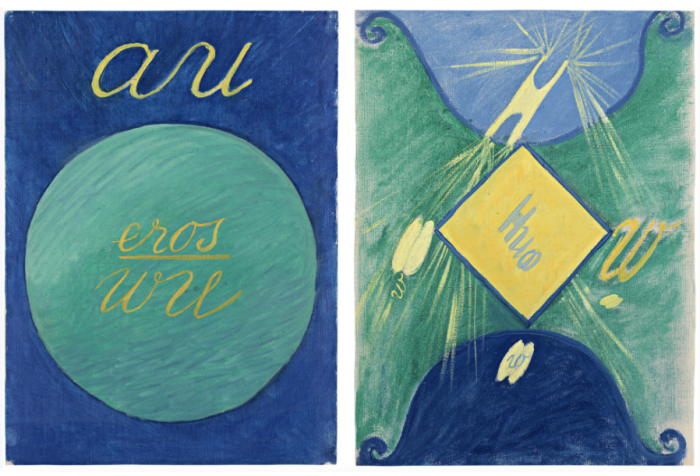
At the heart of the exhibition is a collection of works by the legendary Swedish painter Hilma af Klint, who, guided by mediumistic presences at the start of the twentieth century, developed a completely original abstract language—preceding pioneers of abstraction such as Wassily Kandinsky and Piet Mondrian. This is a rare opportunity to view sixteen of her canvases in Italy, dating back to the very early stages of her “automatic” experimentation. It is also in line with the growing international interest in af Klint’s work, rediscovered by the general public in 2013 thanks to the Venice Biennale (curated by Massimiliano Gioni) and the retrospective organized by the Moderna Museet in Stockholm (then directed by Daniel Birnbaum, who is also the editor of the artist’s catalogue raisonné) and is now the subject of an exhibition at the Museum of Modern Art in New York.
Alongside those of Hilma af Klint, works and documents by other extraordinary historical figures will be presented, including Georgiana Houghton, Emma Kunz, Linda Gazzera, Hélène Smith, Eusapia Palladino, Carol Rama, Man Ray, Pierre Klossowski, Victorien Sardou, Augustin Lesage, Annie Besant, Madge Gill and Wilhelmine Assmann, placed in dialogue with contemporary artists who have explored the same themes through new media and new languages, including Judy Chicago, Kerstin Brätsch, Marianna Simnett, Andra Ursuţa, Diego Marcon, and Chiara Fumai. Also on view will be a few rare volumes from Countess Morando’s library, on loan from the Biblioteca Trivulziana.
“With Fata Morgana, the Fondazione Nicola Trussardi renews its commitment to exploring unexpected artistic territories and giving voice to alternative narratives, bringing contemporary art beyond the boundaries of traditional institutions,” says Beatrice Trussardi, President of the Fondazione Nicola Trussardi. “In the wake of landmark exhibitions such as The Great Mother and The Restless Earth, we now turn our gaze toward the disquieting power of the invisible. In an era increasingly shaped by emergent spiritualities and quests for interior meaning, we have chosen to examine how that which eludes vision has persistently informed the language of art and continues to unsettle the present. It is no coincidence that André Breton’s poem “Fata Morgana” was written in 1940: in times of profound darkness, the impulse to envision elsewhere and to seek connection with imperceptible realms becomes even more imperative. This project arises from the convergence of radical imaginaries and unconventional sensibilities, weaving together art, science, and the unseen in a constellation that eloquently embodies the Foundation’s cultural mission.”
With a selection of over fifty historical and contemporary artists, the Fondazione Nicola Trussardi, through Fata Morgana: Memories of the Invisible, invites us to reconsider the role of the marginal, the inexplicable, and the visionary in artistic creation. The project is entrusted to a curatorial team with extensive international experience—which, for the first time in Italy, includes not one but two former directors of the Venice Biennale—and transforms Palazzo Morando into a portal suspended between past and present, imagination and reality.
Hilma af Klint, Eileen Agar, Aloïse (Aloïse Corbaz), Giulia Andreani, Kenneth Anger, Antonin Artaud, Wilhelmine Assmann, Annie Besant, Hildegard von Bingen, Kerstin Brätsch, André Breton, Marguerite Burnat-Provins, Marian Spore Bush, Claude Cahun, Chiara Camoni, Milly Canavero, Guglielmo Castelli, Ferdinand Cheval, Judy Chicago, Fleury-Joseph Crépin, Maya Deren, Fernand Desmoulin, Marcel Duchamp, Germaine Dulac, Cecilia Edefalk, Max Ernst, Minnie Evans, Madame Favre, Olga Fröbe-Kapteyn, Chiara Fumai, Dominique Fung, Linda Gazzera, Madge Gill, Anna Hackel, Gertrude Honzatko-Mediz, Georgiana Houghton, Anna Mary Howitt Watts, Victor Hugo, Hector Hyppolite, Emma Jung, Corita Kent, Pierre Klossowski, Emma Kunz, Ethel Le Rossignol, Sheila Legge, Augustin Lesage, Lars Olof Loeld, Goshka Macuga, Diego Marcon, James Tilly Matthews, Henry Michaux, Lee Miller, Jacob Mohr, Sister Gertrude Morgan, Jill Mulleady, Nadja (Léona Delcourt), Louise Nevelson, Eusapia Palladino, Paulina Peavy, Stanisłava Popielska, Carol Rama, Man Ray, Victorien Sardou, Marianna Simnett, Hélene Smith (Catherine-Elise Müller), Kiki Smith, Lily Stockman, Rosemarie Trockel, Gustave Pierre Marie Le Goarant de Tromelin, Kaari Upson, Andra Ursuța, Giuseppe Versino, Vanda Vieira-Schmidt, Günter Weseler, Johanna Natalie Wintsch, Adolf Wölfli, Anna Zemánkovà, Unica Zürn.
The Nicola Trussardi Foundation presents a catalogue (bilingual, 248 pages) to accompany the exhibition, published by Electa in the Pesci rossi series. It is edited by Massimiliano Gioni, Daniel Birnbaum and Marta Papini and includes the preface by Beatrice Trussardi, the text by the editors and essays by Jennifer Higgie, Vivienne Roberts and Julia Voss, together with the new translation of the poem Fata Morgana by André Breton , which intertwines history, art and mysticism. With over eighty color images, the publication explores the connections between art, spiritualism, esotericism, and feminism, showcasing the multiple voices of artists, mediums, and visionaries who have spanned history from the 19th century to the present day.